
Indiana Has Circuit and Superior Courts
Howard County's real trial courts are not county district courts. Indiana's Constitution and court system use the Supreme Court, Court of Appeals, Tax Court, Circuit Courts, Superior Courts, and local city or town courts. Howard County has the original Howard Circuit Court, created when the county was organized in 1844, plus four Superior Courts and a magistrate/referee structure.
Howard County is in Judicial District 8 with Cass, Fulton, and Miami counties. Appeals from the county trial courts go to the Court of Appeals of Indiana, and some matters may reach the Indiana Supreme Court. The Howard County Clerk, Debra C. Stewart, is the unified clerk for filings and records support across the local trial courts.
Howard County Court Table
All listed courtrooms are at the Howard County Courthouse, 104 N. Buckeye St., Kokomo, IN 46901, unless noted. MyCase may show the assigned court, case type, filing date, hearing date, and judicial officer. Local contact information remains important because the Circuit Court page warns that hearing-date information should be verified with the court or attorney.
| Court or office | Judge or official | Room and contact | Main researched jurisdiction |
|---|---|---|---|
| Howard County Clerk | Debra C. Stewart | Room 202; phone 765-456-2000; fax 765-456-2267 | Filings, marriage licenses, child support, traffic tickets, fines, fees, judgments, certified-copy routing. |
| Howard Circuit Court | Hon. Lynn Murray; Cheyenne Shepherd, Magistrate; Donald J. Bolinger II, Referee | Room 310; phone 765-456-2202; fax 765-456-2016 | Original county court, general criminal and civil jurisdiction, exclusive juvenile jurisdiction. |
| Howard Superior Court I | County page references Judge Menges; state directory lists Hon. Joshua McMahan | Room 216; phone 765-456-2200 | Primarily criminal drug and domestic-violence cases, Adult Drug Court, Domestic Violence Program, Re-entry Court. |
| Howard Superior Court II | Hon. Blake Dahl | Room 304; phone 765-456-2201; fax 765-456-2936 | General civil and criminal jurisdiction, Mental Health Diversion, Veterans Court. |
| Howard Superior Court III | Hon. Douglas Tate | Room 216; phone 765-456-2220 | Driving offenses, traffic infractions, small claims, and most non-drug misdemeanors. |
| Howard Superior Court IV | Hon. Hans Pate | Room 300; phone 765-456-2900; fax 765-456-2901 | General civil and criminal jurisdiction; began operations January 6, 2006. |
| Howard County Magistrate Court | State directory lists Cheyenne Shepherd as magistrate for Circuit and Superior I | Room 216; no separate phone listed in the county page | Magistrate matters assigned within county trial-court authority. |
Numbered Superior Courts
Source view: the Howard Superior Court I page describes the criminal drug and domestic-violence docket, Adult Drug Court, Domestic Violence Program, and Re-entry Court.
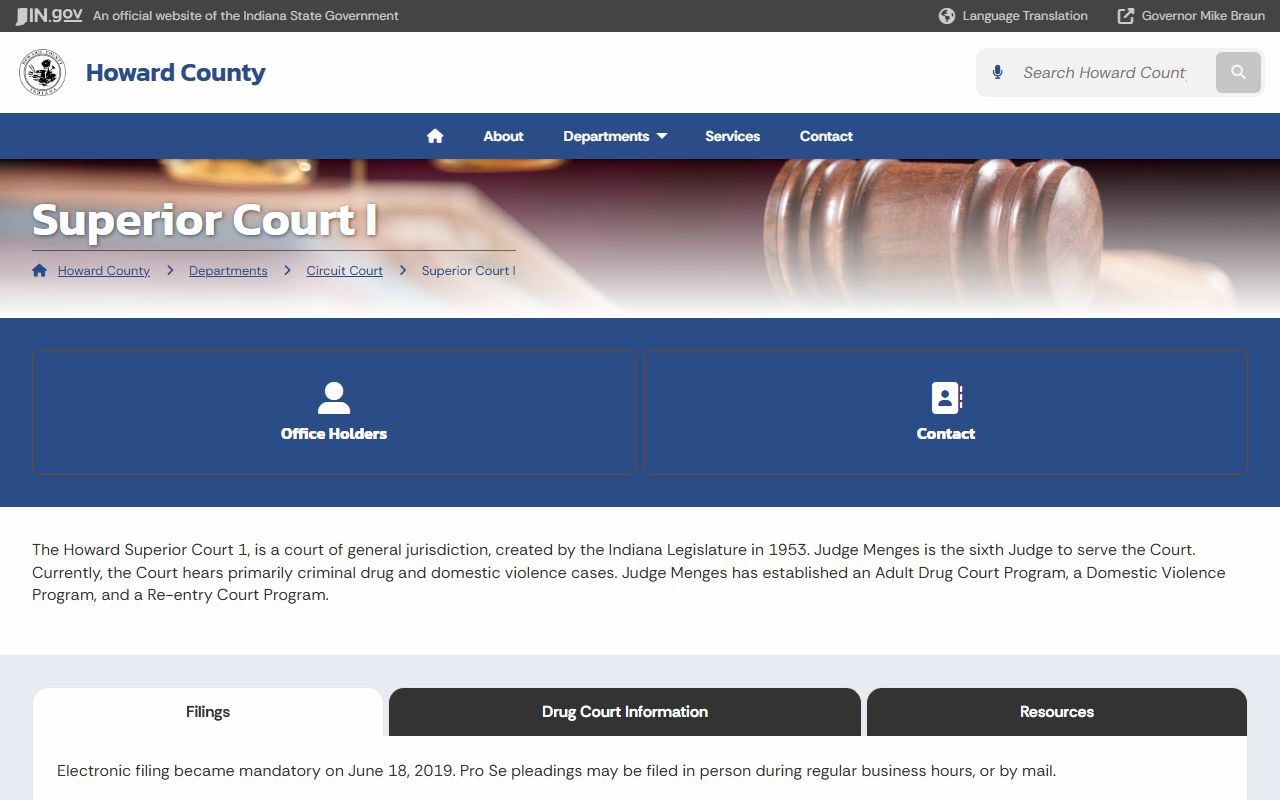
Superior Court I is the most important local page for drug, domestic-violence, re-entry, and Adult Drug Court context.
Source view: the Howard Superior Court II page identifies general jurisdiction, Mental Health Diversion, and Veterans Court connections.
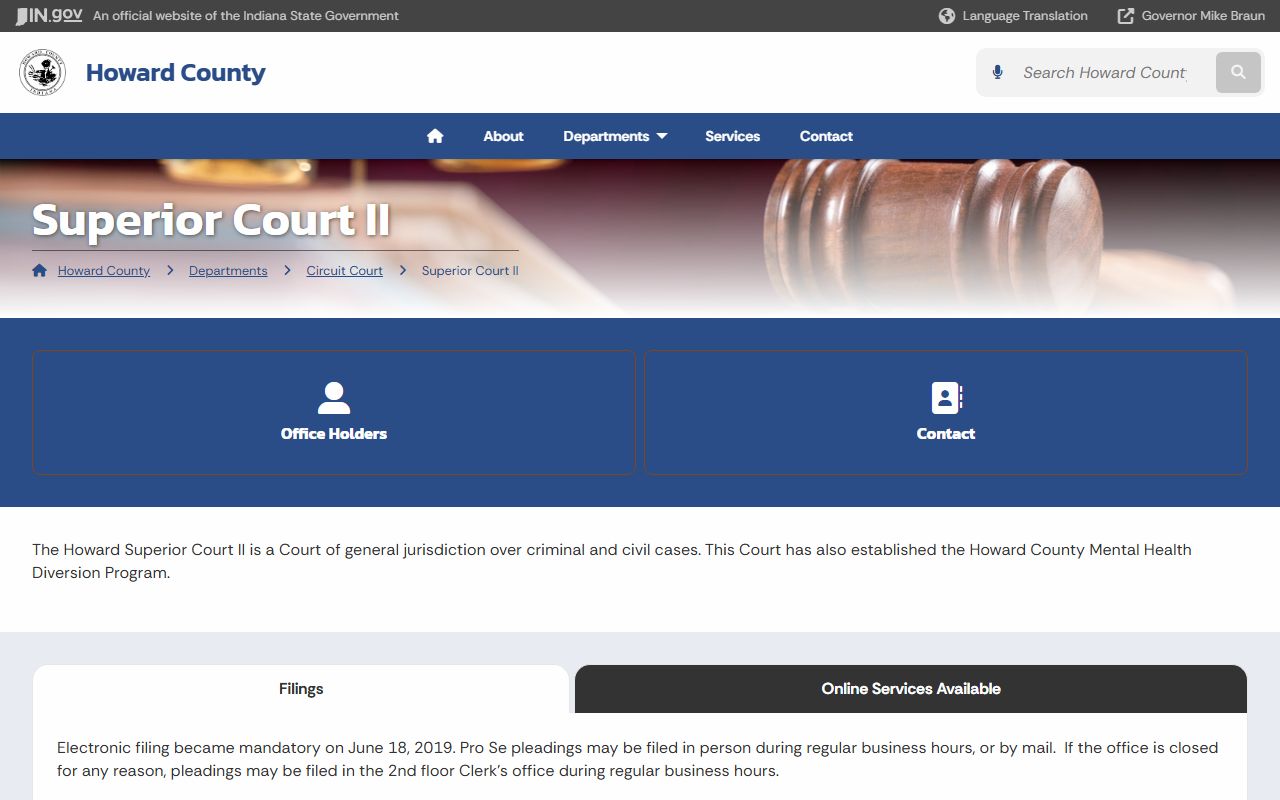
Superior Court II matters can involve ordinary civil or criminal cases as well as diversion-oriented programs that may affect what appears publicly.
Source view: the Howard Superior Court III page is the local source for traffic, driving, small-claims, and non-drug misdemeanor assignments.
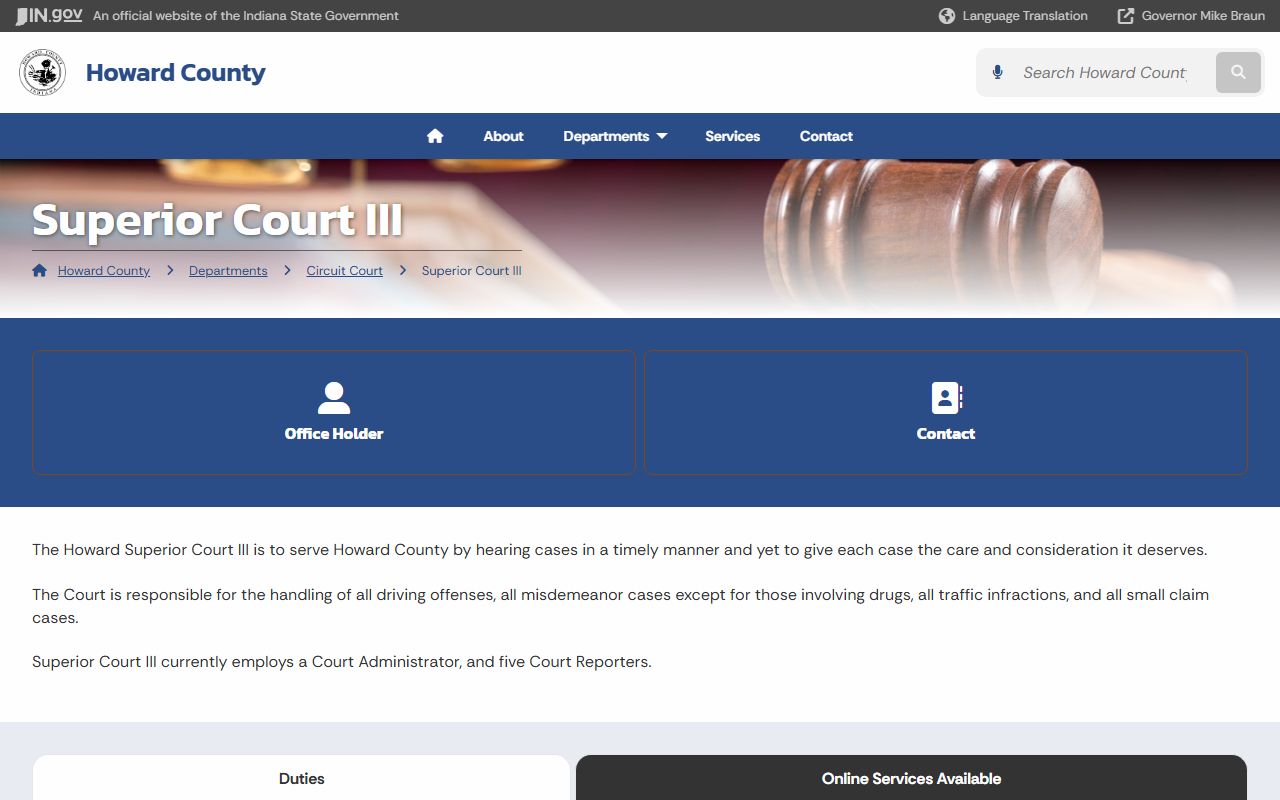
Superior Court III should be checked first for traffic infractions, driving offenses, small claims, and many misdemeanor records.
Source view: the Howard Superior Court IV page lists general civil and criminal jurisdiction and the Room 300 contact block.
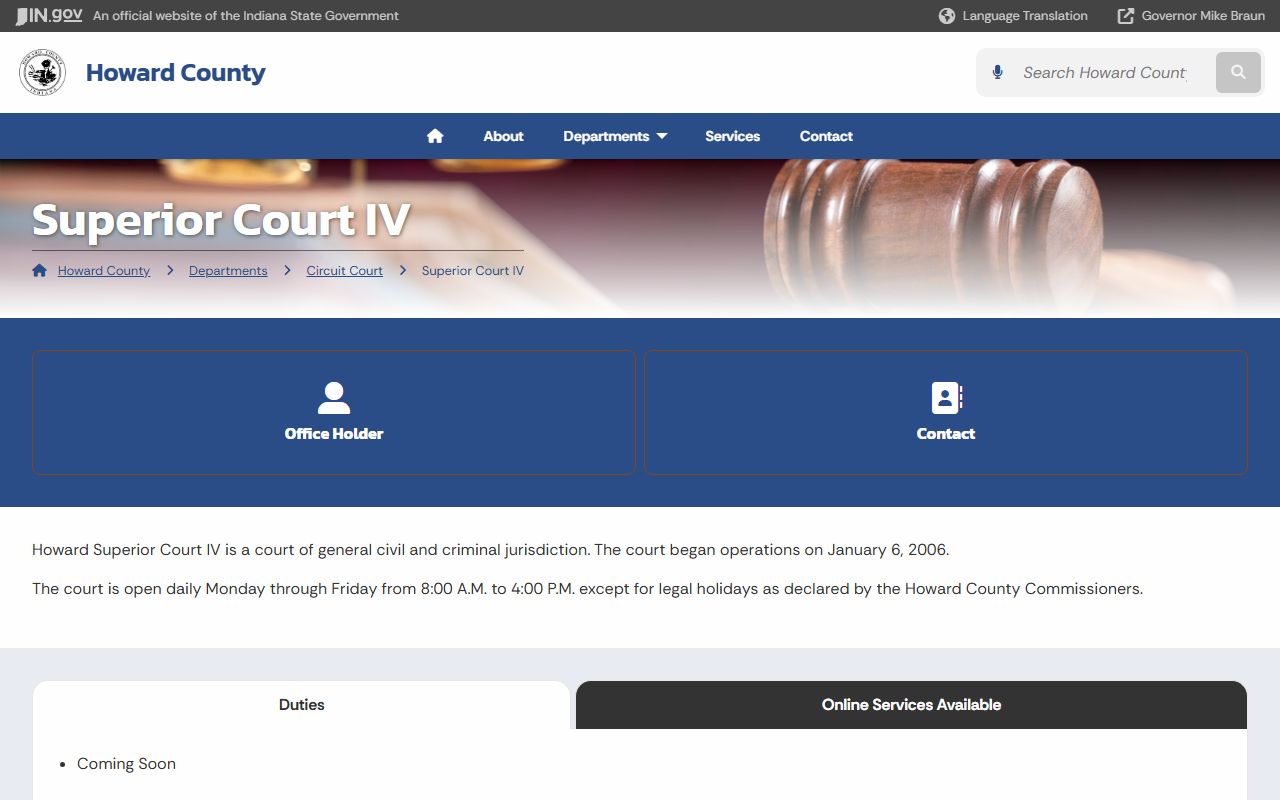
Superior Court IV adds local trial-court capacity for general civil and criminal work and has its own published phone and fax numbers.
Source view: the Howard County Magistrate Court page confirms the courthouse Room 216 location and weekday hours for magistrate matters.
The magistrate page helps explain why a hearing may be handled by a judicial officer even when the case remains assigned to a named Circuit or Superior Court.
Circuit and Superior Courts Compared
Indiana trial-court names reflect legislation and local history more than a simple hierarchy of county versus district court. In Howard County, Circuit and Superior Courts are both trial courts. The practical difference is the local case assignment described by county pages and local rules.
| Feature | Howard Circuit Court | Howard Superior Courts | Magistrate or local lower-court role |
|---|---|---|---|
| Historical role | Original county court created with the county in 1844. | Numbered trial courts added by state legislation and local need. | Supports assigned proceedings within trial-court authority. |
| Core jurisdiction | General civil and criminal jurisdiction plus exclusive juvenile jurisdiction. | General civil and criminal work, with local case-type specializations. | Hears matters as assigned or approved by the judge of the court. |
| Traffic and small claims | Not the main researched traffic/small-claims source. | Superior Court III handles all traffic infractions, driving offenses, small claims, and most non-drug misdemeanors. | May sit on assigned proceedings if authorized. |
| Specialty courts | Juvenile Problem Solving Program. | Drug Court and Re-entry in Superior I; Mental Health Diversion and Veterans Court in Superior II. | Supports the trial courts rather than creating a separate public record system. |
How a Case Moves Through Howard County
Howard County criminal cases usually begin with investigation by law enforcement, review by the prosecutor, and filing if the prosecutor determines sufficient evidence exists. Once filed, MyCase can show public docket information such as cause number, court, charges, hearing dates, CCS entries, bond, disposition, sentencing, and financial entries where public. Jail custody on the sheriff site is separate from filed court charges.
Criminal flow: investigation or arrest › prosecutor review › case filed in Howard Circuit or Superior Court › initial hearing and bond/no-contact terms › pretrial hearings or diversion review › plea, dismissal, trial, or disposition › sentencing, probation, restitution, or appeal.
Civil and probate flow: complaint or petition filed with the clerk › service or notice › answer or response › hearings, motions, mediation, inventory, accounting, or discovery as applicable › order, judgment, final report, or closing entry › post-judgment activity or appeal.
Traffic and small-claims flow: ticket or claim filed › Superior Court III docket or payment eligibility › hearing, admission, contest, default, judgment, or disposition › payment, BMV reporting, collection, or further court action if required.
Local Rules and Acting Judges
The Howard County local court rules PDF is an official source for caseload allocation, acting-judge authority, appearances, court reporter services, and local procedures. The manifest screenshot capture for the PDF failed because the browser treated it as a download, but the local rules should still be linked as an official court resource: Howard County local court rules.
The researched local rules explain that Superior Court judges authorize the Circuit Court judge to sit as judge of the Superior Courts, and the Circuit Court judge authorizes Superior Court judges to sit in Circuit Court. The magistrate is also authorized to sit as a judicial officer for Howard Circuit and Superior Courts with the approval of the judge of that court. For users, this means the case title, court number, courtroom, and judicial officer may not always match in a simple one-to-one way.
Specialty Courts and Record Access
Howard County's trial courts have several problem-solving programs. Superior Court I has Adult Drug Court, Domestic Violence Program, and Re-entry Court. Adult Drug Court began in February 2007 and uses a sentencing-withheld model involving the judge, prosecutor, public defender, drug court staff, probation, and treatment providers. Graduation can lead to dismissal of pending charges, while termination returns the case for sentencing.
Superior Court II has Mental Health Diversion and a Veterans Court connection. Circuit Court has a Juvenile Problem Solving Program and exclusive juvenile jurisdiction. These programs are important for understanding case movement, but treatment, pretrial supervision, substance-abuse, mental-health, juvenile, and problem-solving court records may be restricted under Indiana Access to Court Records Rule 5.
Courthouse Access and Copies
The courthouse-centered structure matters for records work. The Howard County Clerk is in Room 202, Circuit Court is listed in Room 310, Superior Court II is in Room 304, Superior Court III and Magistrate Court list Room 216, and Superior Court IV lists Room 300. A MyCase result can identify the court and next hearing, but the room, judicial officer, or schedule should be confirmed when a missed hearing, continuance, warrant, or same-day appearance is at stake.
Official copies follow the same local path. Certified court records, certified divorce decrees, probate copies, wills that are not online, and older documents are requested from the clerk or court maintaining the file. The county research did not locate a courthouse visitor guide with parking rates, security screening rules, or public transit details, so users should rely on the courthouse address and published phone numbers rather than guessing. Attorneys must e-file pleadings, while self-represented parties may use in-person or mail routes where the court page allows them.